By Louise
Dios mios! Cielos! My family has turned into a bunch of whiners. They’re all complaining that they are doing all the writing and I haven’t done anything. If I weren’t stuck with them for the next month... The reality is, I can’t keep up with Andrew’s humor and our kids’ stories. I’m not sure what to write about, plus I’m feeling a tad grumpy.
See, we knew our luck had to run out at some point. Yet the loss of our travel kharma still managed to take us by surprise and has left us all feeling a bit irritated. What happened? This last house we rented was way off from the owner’s description. Before you all start muttering that we’re a bunch of idiots to believe any online rental offer, let me just state that this was not our first rental. It was our tenth and our first dud.
Still, I know some of you are thinking: Why even consider renting in the first place? To put it simply: Kids, convenience, cost.
Before Graham burst onto the scene, we promised ourselves that kids would not stop us from traveling. We’re also realistic and knew that the way we traveled would have to change. No more staying in those, ah, character-building places (to use Andrew’s words). Moving around a lot wasn’t going to happen either. Eating out every meal? Sounds like fun with a toddler in tow. Not. And of course, there was our budget. Can you spell T-I-G-H-T?
So, starting a decade ago, we started renting vacation houses and apartments online. It meant taking a leap of faith and trusting the photos and write-ups. Lo and behold, every single place we rented was just as pictured, until this one.
Last month, northern Costa Rica was shaken by an earthquake. Downed trees and other debris made the Rio Sarapiqui and Rio San Juan un-navigable. Coincidentally, these were the same two rivers we had planned to explore for a week using local riverboat taxis. The boats were no longer running. We needed a Plan B, so we turned to our favorite Internet rental agencies for help.
We had recently spent a week on Costa Rica’s Pacific coast, but we felt that the area was too built up and expensive. We could have spent another week in the area around volcano Arenal—we had a lot of fun there—but it was also beyond our budget. Instead, we decided to head to the Caribbean coast, where we had already rented a house on the beach for our last month. With high season in top gear, most of the rentals were booked, but then we happened upon a place called Mono En La Cara. It promised everything from a fully equipped kitchen to Internet service. The online description said they even had satellite TV and a DVD/CD player. We really haven’t missed TV, so that was no big deal, but it did lead us to believe that the house with ocean views in the middle of a tropical paradise was going to be of a certain quality. We emailed the owners (who live in Allentown, PA) and they responded. They sounded nice, so we made the arrangements.
A couple of days later, we boarded a bus to Puerto Viejo, on Costa Rica’s southern Caribbean coast, close to Panama. I should mention here that a few travelers, including some Costa Ricans, told us we might want to rethink spending five weeks on the Caribbean coast. Their warnings began: “Oh, the Caribbean coast… You don’t want to go there. The water is rough. The place is filthy. Snorkeling? Ha! You won’t see any fish because the reef is dead. It’s like going to Jamaica…” It went on and on. Their comments struck us as strange because all our earlier research suggested just the opposite. We’re laid-back travelers, not tourists, as the kids will tell you, so we pushed these warnings aside. We had our sights set on kicking back in a tropical house while listening to Caribbean sounds as we cooked up coconut curries and drank rum cocktails.
We boarded the bus and headed toward the coast. Arriving on the coast at Limon, the warnings turned to reality. Just 70 miles from our destination, garbage started appearing along the road. Intense rains had caused flooding in some areas and the rivers flowed with murky brown water that poured into the sea. Andrew and I stared out the bus window in horror. What had we done? The area was totally unlike any other part of Costa Rica we had visited. It looked as if we had entered a third-world country, not a tropical paradise.
Trying not to panic (while listening to Graham’s running commentary about the brown ocean and the plastic bags lining the road) we held tight. Puerto Viejo was still miles away to the south. The situation could change.
And so it did. The ocean at Puerto Viejo was clear and gorgeous. The high-tide line was littered with branches and coconuts, not garbage. The town was busy, filled with restaurants, shops, and enough American and European tourists that you couldn’t swing a surfboard without knocking one over.
The problem: the house. Not only was the area around the house not as described (picture a large pile of abandoned construction material in the middle of the yard, and the special outdoor eating area filled with scraps of wood, paint rollers, a rusty wheel barrow, bags of garbage, and two splinter-filled benches). As for the fully equipped kitchen, maybe in PA this doesn’t include pots, chopping knives, cutting board….oh the list goes on. Internet service? In our dreams. And the only music we heard was from the neighbor’s hammers. Follow up emails from an Internet café to the couple from PA were duly ignored. But we did notice that they managed to go onto their website and reword their listing pretty darn fast.
With all this said, we have enjoyed our week — outside this depressing house — in Puerto Viejo. The kids are learning to surf. We’ve knocked coconuts out of trees. And taken long walks on the beach. We are keeping our fingers crossed that the place we’ve rented for our last month is true to its word. Meanwhile, I hope I’ve got my family off my back about not writing. Now it’s time to put a little lime in the coconut and drink it all up.
Sunday, March 1, 2009

My Dad: A Champion!
By Katharine
Some caterpillars can be very dangerous. Here in Puerto Viejo, Costa Rica, they call caterpillars worms. On the beaches of Puerto Viejo grow almond trees. A butterfly lays her eggs in an almond tree and a few days later the worms or caterpillars are born. The caterpillars fall out of the trees and land in the sand. These caterpillars look like fuzzy sticks with hairs.
If a person accidentally steps on one of the caterpillars it squirts poison into the person’s foot. In 25 minutes the person’s body will be in complete pain. I have heard it feels as if you are on fire. The pain goes away in four hours on its own. But, if you go visit the Worm Bite Specialist, the pain will go away in five minutes with a special shot. The Worm Bite Specialist is also a regular doctor.
My Dad went to the Worm Bite Specialist because Dad’s ears were plugged and he could not hear well. We walked into the doctor’s office and sat down and began to read a magazine, when a man walked in. The man was so fat he looked as if he was going to have six babies all at once! He immediately started a conversation. We found out in the first five minutes that he was 70 years old and from California. When his mother died she left him a fortune. He told us about his money, cats, and about being robbed a lot.
No wonder he gets robbed a lot, he cannot stop talking about his money! Thankfully the receptionist called us into the doctor’s office. The office had a breathing mask, an oxygen cylinder, and bandages. On the shelves were lots of papers. First, the doctor handed my Dad a bowl which Dad put up to his neck. Next, the doctor took a syringe pushed water into Dad’s ears. Then he took a pair of tweezers and stuck them into my Dad’s ears and pulled out a piece of wax. The doctor was being funny and called the piece of wax ‘brother’ because it was so big. After that, he pulled out sister wax, mom wax, and dad wax which completed a small family. Last he took out the grandpa. It was a piece of wax the size of a marble. It was yellow, big, and GROSS! The doctor said my Dad was the champion of the most and biggest wax in all of Puerto Viejo. I am proud of my Dad!
GROSS! GROSS!
Some caterpillars can be very dangerous. Here in Puerto Viejo, Costa Rica, they call caterpillars worms. On the beaches of Puerto Viejo grow almond trees. A butterfly lays her eggs in an almond tree and a few days later the worms or caterpillars are born. The caterpillars fall out of the trees and land in the sand. These caterpillars look like fuzzy sticks with hairs.
If a person accidentally steps on one of the caterpillars it squirts poison into the person’s foot. In 25 minutes the person’s body will be in complete pain. I have heard it feels as if you are on fire. The pain goes away in four hours on its own. But, if you go visit the Worm Bite Specialist, the pain will go away in five minutes with a special shot. The Worm Bite Specialist is also a regular doctor.
My Dad went to the Worm Bite Specialist because Dad’s ears were plugged and he could not hear well. We walked into the doctor’s office and sat down and began to read a magazine, when a man walked in. The man was so fat he looked as if he was going to have six babies all at once! He immediately started a conversation. We found out in the first five minutes that he was 70 years old and from California. When his mother died she left him a fortune. He told us about his money, cats, and about being robbed a lot.
No wonder he gets robbed a lot, he cannot stop talking about his money! Thankfully the receptionist called us into the doctor’s office. The office had a breathing mask, an oxygen cylinder, and bandages. On the shelves were lots of papers. First, the doctor handed my Dad a bowl which Dad put up to his neck. Next, the doctor took a syringe pushed water into Dad’s ears. Then he took a pair of tweezers and stuck them into my Dad’s ears and pulled out a piece of wax. The doctor was being funny and called the piece of wax ‘brother’ because it was so big. After that, he pulled out sister wax, mom wax, and dad wax which completed a small family. Last he took out the grandpa. It was a piece of wax the size of a marble. It was yellow, big, and GROSS! The doctor said my Dad was the champion of the most and biggest wax in all of Puerto Viejo. I am proud of my Dad!
GROSS! GROSS!
Turning Blue
By Graham
The sky was overcast. It had started to drizzle. We were hiking on the slopes of the dormant volcano Tenorio toward the Rio Celeste.
The air was muggy and thick. Tall trees loomed over us, barely letting light in. This is the primary rainforest. Small dirt trails wound around tree roots and plants. The rainforest around Tenorio was different from other rainforests we have visited; it was a ton wetter. Moss grew everywhere, and giant tree ferns with monkey-like tails grew next to the path.
A little way in, the jungle thickened. We heard the sound of rushing water. We had come to our first obstacle. A small river, which we had to cross by hopping stones, flowed by at a fast pace. We stumbled across.
The trail became muddier, steeper, and narrower. We started to slip and slide. I noticed a hole in the ground and walked over to see what lived in it. YELP!!! I jumped back. The air coming out of it was super hot. The steam came from lava warming an underground river. After that, we saw many more steam vents, reminding us that we were hiking on a volcano.
I heard the sound of rushing water again. We arrived at another river, and my family froze like statues. The river water was the most gorgeous bright blue, unlike the blue that you see in oceans or lakes. This blue was formed by a chemical reaction of copper, carbonates, and sulfur coming from underwater volcanic vents. A waterfall, with a sound like thunder, shot out of the green jungle and fell into a blue pool below.
Further upstream we saw where a volcanic vent added the copper to the clear river water, turning it blue.
From there, we started to walk to a natural hot spring. The trail became so steep and slippery it was nearly impossible for Katharine and me to climb up. We were starting to tire. As we crossed a log bridge with no rails, Katharine lost her footing. Slurp! She fell into the mud. As Dad tried to pull her out, I walked on. Soon I was calling for help because I had fallen off the bridge and my foot was stuck in the mud. As I tried to pull my foot out, my shoe nearly came off. When I looked back at Katharine I burst into laughter. She was covered in mud.
The hot spring bubbled up from a hole in the rock at the edge of the blue river. Park rangers had used boulders to create a small pool where you could relax in the hot water. We stripped down to our swimsuits and bathed for a half hour.
On the way back to our car, the guide suddenly stopped. He whispered that he had spotted the bare-necked umbrella bird. It must have been our lucky day. The umbrella bird is very rare to see. The guide had only seen it once, two years earlier. We had been dying to see an umbrella bird ever since we mistook a crested guan for one while hiking in another park. The bird had a mohawk array of head feathers and a big red wattle. Behind it was the female; she was all black. The birds flew all around us, even right above us.
When we emerged out of the forest we were so tired we could barely stand. After seven hours of walking we were ready to go home.

Some people pay extra for mud baths.

This time, the hot air isn't coming from Graham.

Blue lagoon. Donde esta Brooke?


Where the river starts to feel blue

The author considers his next masterpiece
The sky was overcast. It had started to drizzle. We were hiking on the slopes of the dormant volcano Tenorio toward the Rio Celeste.
The air was muggy and thick. Tall trees loomed over us, barely letting light in. This is the primary rainforest. Small dirt trails wound around tree roots and plants. The rainforest around Tenorio was different from other rainforests we have visited; it was a ton wetter. Moss grew everywhere, and giant tree ferns with monkey-like tails grew next to the path.
A little way in, the jungle thickened. We heard the sound of rushing water. We had come to our first obstacle. A small river, which we had to cross by hopping stones, flowed by at a fast pace. We stumbled across.
The trail became muddier, steeper, and narrower. We started to slip and slide. I noticed a hole in the ground and walked over to see what lived in it. YELP!!! I jumped back. The air coming out of it was super hot. The steam came from lava warming an underground river. After that, we saw many more steam vents, reminding us that we were hiking on a volcano.
I heard the sound of rushing water again. We arrived at another river, and my family froze like statues. The river water was the most gorgeous bright blue, unlike the blue that you see in oceans or lakes. This blue was formed by a chemical reaction of copper, carbonates, and sulfur coming from underwater volcanic vents. A waterfall, with a sound like thunder, shot out of the green jungle and fell into a blue pool below.
Further upstream we saw where a volcanic vent added the copper to the clear river water, turning it blue.
From there, we started to walk to a natural hot spring. The trail became so steep and slippery it was nearly impossible for Katharine and me to climb up. We were starting to tire. As we crossed a log bridge with no rails, Katharine lost her footing. Slurp! She fell into the mud. As Dad tried to pull her out, I walked on. Soon I was calling for help because I had fallen off the bridge and my foot was stuck in the mud. As I tried to pull my foot out, my shoe nearly came off. When I looked back at Katharine I burst into laughter. She was covered in mud.
The hot spring bubbled up from a hole in the rock at the edge of the blue river. Park rangers had used boulders to create a small pool where you could relax in the hot water. We stripped down to our swimsuits and bathed for a half hour.
On the way back to our car, the guide suddenly stopped. He whispered that he had spotted the bare-necked umbrella bird. It must have been our lucky day. The umbrella bird is very rare to see. The guide had only seen it once, two years earlier. We had been dying to see an umbrella bird ever since we mistook a crested guan for one while hiking in another park. The bird had a mohawk array of head feathers and a big red wattle. Behind it was the female; she was all black. The birds flew all around us, even right above us.
When we emerged out of the forest we were so tired we could barely stand. After seven hours of walking we were ready to go home.

Some people pay extra for mud baths.

This time, the hot air isn't coming from Graham.

Blue lagoon. Donde esta Brooke?


Where the river starts to feel blue

The author considers his next masterpiece
Monday, February 23, 2009
Pigs In a Blanket
By Katharine Frances Barbour
It was a dark and stormy night when we finally reached our hotel, Leaves & Lizards, overlooking Costa Rica’s Arenal Volcano. It had taken nine long, hard hours to get there from Samara.
The owners of Leaves & Lizards also ran a farm across the road. After we looked around the hotel, we headed toward the barn. It had nine horses and about fifty chickens and four turkeys. I was most interested in a cement stall in which stood a pregnant piece of bacon. Well, it was not bacon yet but if my dad had a knife we would have had a nice breakfast. The pig was as big as a full-size refrigerator. I didn’t want to go in the stall because I was afraid of getting crushed to death.
The owner, Debbie, said that the pig might have its babies that night. She promised that she would wake us up if that happened. The next day, though, the pig still had not given birth. So, we set off to do chores with the caretaker, Carlos. We collected the eggs, and fed and brushed the horses. We could not milk the cow because it was away getting bred with a bull.
Every time we returned from a hike or a trip, we would look in and see if the pig had had her piglets. Four days went by without any piglets, but on the fifth day she had them. Thirteen little piglets, three girls and ten boys. They were brown, pink, pink with black spots, and brown with black spots. When you picked one up, it would scream like crazy. They sounded like human babies. I thought they were adorable.
I sat in the stall with the piglets for hours watching them. They would fight over milk and get squashed by each other. They fell asleep drinking milk. My favorite piglet was the first born. He was pinkish-white and the size of both my hands. He was one of the weakest, probably a runt. He would try to get milk but he wasn’t tall enough to reach it, so he would go to the bottom and get squashed.
Debbie said that the strongest piglets would go in a different pen after six weeks, and the runts would stay for a couple more weeks with their mom.
On the last day my brother and I got to milk a cow. Milking the cow felt really cool because the udders were like jets. When you squeezed a teat, the milk would shoot everywhere. We got 2 gallons of milk. Debbie and her husband Steve will make cheese, butter, and buttermilk with it.

Miss Piggy,um, where's Kermit?

Jamón, Proscuitto, Serrano, Cappacola, Chorizo, Smithfield...

I'm calling him Bacon!

Boston Butt?

Udderly fascinating.
It was a dark and stormy night when we finally reached our hotel, Leaves & Lizards, overlooking Costa Rica’s Arenal Volcano. It had taken nine long, hard hours to get there from Samara.
The owners of Leaves & Lizards also ran a farm across the road. After we looked around the hotel, we headed toward the barn. It had nine horses and about fifty chickens and four turkeys. I was most interested in a cement stall in which stood a pregnant piece of bacon. Well, it was not bacon yet but if my dad had a knife we would have had a nice breakfast. The pig was as big as a full-size refrigerator. I didn’t want to go in the stall because I was afraid of getting crushed to death.
The owner, Debbie, said that the pig might have its babies that night. She promised that she would wake us up if that happened. The next day, though, the pig still had not given birth. So, we set off to do chores with the caretaker, Carlos. We collected the eggs, and fed and brushed the horses. We could not milk the cow because it was away getting bred with a bull.
Every time we returned from a hike or a trip, we would look in and see if the pig had had her piglets. Four days went by without any piglets, but on the fifth day she had them. Thirteen little piglets, three girls and ten boys. They were brown, pink, pink with black spots, and brown with black spots. When you picked one up, it would scream like crazy. They sounded like human babies. I thought they were adorable.
I sat in the stall with the piglets for hours watching them. They would fight over milk and get squashed by each other. They fell asleep drinking milk. My favorite piglet was the first born. He was pinkish-white and the size of both my hands. He was one of the weakest, probably a runt. He would try to get milk but he wasn’t tall enough to reach it, so he would go to the bottom and get squashed.
Debbie said that the strongest piglets would go in a different pen after six weeks, and the runts would stay for a couple more weeks with their mom.
On the last day my brother and I got to milk a cow. Milking the cow felt really cool because the udders were like jets. When you squeezed a teat, the milk would shoot everywhere. We got 2 gallons of milk. Debbie and her husband Steve will make cheese, butter, and buttermilk with it.

Miss Piggy,um, where's Kermit?

Jamón, Proscuitto, Serrano, Cappacola, Chorizo, Smithfield...

I'm calling him Bacon!

Boston Butt?

Udderly fascinating.
Ant She Sweet
By Andrew
I’m starting to worry about our children. While we were in Ecuador, I was tickled to see the children attack strange new foods with gusto: They would have made an anteater proud the way they hoovered up lemon ants in the Amazon jungle; a jaguar could not have dismembered a guinea pig with greater élan. If it moved, they ate it, mainly because the locals seemed happy to eat it, too.
With our shift to Costa Rica, I thought that such adventures were behind us. In many ways, Costa Rica could qualify as the 51st state. San Jose is a neon blur of McDonald’s, Burger Kings, Taco Bells, and Pizza Huts. Tour buses disgorge hordes of American and European visitors at the country’s major sights; expat Americans have built homes in every little beach hamlet. And, distressingly, our Spanish has ground to a halt because everyone seems to speak English rather well—certainly better than we speak Spanish.
I fully expected our kids to start ordering hamburguesas y papas fritas at every stop. A little American-style cholesterol to clear the palate. But no. It seems our kids have gone wild. Mowgli and Baloo have arrived in Costa Rica.
A week ago, we took a boat tour up the Rio Negro, on the Nicaraguan border. On board was a large family from Buffalo on spring break and a couple of newlyweds from Orlando. In many ways, it was a gentle repeat of earlier adventures. A guide pointed out howler and capuchin monkeys, caimans, sloths, and a wide variety of river birds.
Toward the end of the trip, the captain nosed the boat into the bank so we could disembark to look for roseate spoonbills in an adjoining marsh. The spoonbills had obviously run away with some dish, so we traipsed back toward the boat.
Graham suddenly gave a small cry, not dissimilar to the noise made by my mother upon opening a box of chocolate truffles. He bent down and picked up a dried acacia seed pod on which a few ants were visible.
“Can we eat them?” he asked the guide.
The guide, obviously unaware that our children were raised by wolves, misunderstood the question.
“The seeds? No, you cannot eat them. But look inside.” He broke the pod in two and termites poured out.
“We call these carrots of the forest,” he continued. “The indigenous people eat…”
He got no further before Katharine snared some termites from the pod and prepared for inhalation.
“No!!!!!” screamed a young university student from the Buffalo family, grabbing Katharine’s hand and wrenching it away from her mouth.
A look of utter confusion crossed Katharine’s face. Had she committed some breach of etiquette? Should she have offered her elders the termites first?
The student, who obviously felt that she had saved a challenged child from imminent harm, held Katharine in a vice-like grip while giving us an accusatory stare.
“Do they really taste like carrots?” asked Louise. “The last ones we ate tasted like citrus.”
Sensing that she was holding the cub of a deranged and possibly dangerous family, the student sprang away from Katharine, who immediately declared that it was snack time.
Graham and Katharine set about the termites, comparing tasting notes, while the student did dry heaves in the leaf litter by the boat.
Two days later, we were hiking with our guide through thick primary forest on the slopes of Volcan Tenorio, one of Costa Rica’s many dormant volcanoes. We stopped to examine a bullet ant, a very large specimen named for the extreme pain caused by its bite—and its sting.
“Can I eat it?” asked Graham. Slightly nonplussed, the guide explained that the mandibles of the ant would surely give your lip or tongue a nasty bite, to say nothing of the ant’s stinger.
“What if we ripped off its head and bottom and just ate the middle bit,” queried Katharine.
After that, the guide picked up his pace noticeably. I think he was worried about being caught in the rainforest with us after dusk.
I’m starting to worry about our children. While we were in Ecuador, I was tickled to see the children attack strange new foods with gusto: They would have made an anteater proud the way they hoovered up lemon ants in the Amazon jungle; a jaguar could not have dismembered a guinea pig with greater élan. If it moved, they ate it, mainly because the locals seemed happy to eat it, too.
With our shift to Costa Rica, I thought that such adventures were behind us. In many ways, Costa Rica could qualify as the 51st state. San Jose is a neon blur of McDonald’s, Burger Kings, Taco Bells, and Pizza Huts. Tour buses disgorge hordes of American and European visitors at the country’s major sights; expat Americans have built homes in every little beach hamlet. And, distressingly, our Spanish has ground to a halt because everyone seems to speak English rather well—certainly better than we speak Spanish.
I fully expected our kids to start ordering hamburguesas y papas fritas at every stop. A little American-style cholesterol to clear the palate. But no. It seems our kids have gone wild. Mowgli and Baloo have arrived in Costa Rica.
A week ago, we took a boat tour up the Rio Negro, on the Nicaraguan border. On board was a large family from Buffalo on spring break and a couple of newlyweds from Orlando. In many ways, it was a gentle repeat of earlier adventures. A guide pointed out howler and capuchin monkeys, caimans, sloths, and a wide variety of river birds.
Toward the end of the trip, the captain nosed the boat into the bank so we could disembark to look for roseate spoonbills in an adjoining marsh. The spoonbills had obviously run away with some dish, so we traipsed back toward the boat.
Graham suddenly gave a small cry, not dissimilar to the noise made by my mother upon opening a box of chocolate truffles. He bent down and picked up a dried acacia seed pod on which a few ants were visible.
“Can we eat them?” he asked the guide.
The guide, obviously unaware that our children were raised by wolves, misunderstood the question.
“The seeds? No, you cannot eat them. But look inside.” He broke the pod in two and termites poured out.
“We call these carrots of the forest,” he continued. “The indigenous people eat…”
He got no further before Katharine snared some termites from the pod and prepared for inhalation.
“No!!!!!” screamed a young university student from the Buffalo family, grabbing Katharine’s hand and wrenching it away from her mouth.
A look of utter confusion crossed Katharine’s face. Had she committed some breach of etiquette? Should she have offered her elders the termites first?
The student, who obviously felt that she had saved a challenged child from imminent harm, held Katharine in a vice-like grip while giving us an accusatory stare.
“Do they really taste like carrots?” asked Louise. “The last ones we ate tasted like citrus.”
Sensing that she was holding the cub of a deranged and possibly dangerous family, the student sprang away from Katharine, who immediately declared that it was snack time.
Graham and Katharine set about the termites, comparing tasting notes, while the student did dry heaves in the leaf litter by the boat.
Two days later, we were hiking with our guide through thick primary forest on the slopes of Volcan Tenorio, one of Costa Rica’s many dormant volcanoes. We stopped to examine a bullet ant, a very large specimen named for the extreme pain caused by its bite—and its sting.
“Can I eat it?” asked Graham. Slightly nonplussed, the guide explained that the mandibles of the ant would surely give your lip or tongue a nasty bite, to say nothing of the ant’s stinger.
“What if we ripped off its head and bottom and just ate the middle bit,” queried Katharine.
After that, the guide picked up his pace noticeably. I think he was worried about being caught in the rainforest with us after dusk.
Go With the Flow
By Graham
We were walking on a small trail winding in and out of the Costa Rican jungle. In the distance we could see our destination, Volcano Arenal. One of six active volcanoes in Costa Rica, Arenal looks just the way you would imagine: It’s a perfect cone. Rain forest covers the lower slopes, while higher up the mountain is bare volcanic rock. Steam pours out of the crater at the top.
About halfway along the trail, we heard a sound like thunder. What could it be? Was it a storm? Emerging from the jungle, we came face to face with a wall of volcanic rock. It was about 20 feet high and was formed during an eruption in 1992. When we reached the top, we all gasped. We had a great view of Arenal. We hiked over the old lava flow until we reached the end of the trail. We could go no further because of the danger of being caught in an eruption. I climbed to the top of a very tall rock. There I sat and watched the mountain.
Suddenly, I saw dust billowing up on the right flank of the volcano and heard the rumbling noise again. An eruption sent half-molten boulders bouncing down the mountain. They sounded like a wrecking ball destroying a building. Because we were so far away, the boulders looked like little black marbles, but they were actually about the size of a tractor-trailer. A massive cloud of dust and smoke exploded behind them.
We all thought of how painful it would be to be flattened by one. Now we are excited about hiking the dormant volcano Tenorio.


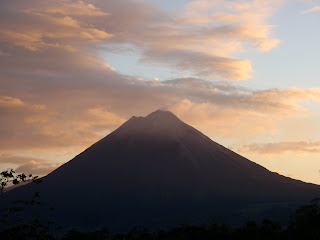
We were walking on a small trail winding in and out of the Costa Rican jungle. In the distance we could see our destination, Volcano Arenal. One of six active volcanoes in Costa Rica, Arenal looks just the way you would imagine: It’s a perfect cone. Rain forest covers the lower slopes, while higher up the mountain is bare volcanic rock. Steam pours out of the crater at the top.
About halfway along the trail, we heard a sound like thunder. What could it be? Was it a storm? Emerging from the jungle, we came face to face with a wall of volcanic rock. It was about 20 feet high and was formed during an eruption in 1992. When we reached the top, we all gasped. We had a great view of Arenal. We hiked over the old lava flow until we reached the end of the trail. We could go no further because of the danger of being caught in an eruption. I climbed to the top of a very tall rock. There I sat and watched the mountain.
Suddenly, I saw dust billowing up on the right flank of the volcano and heard the rumbling noise again. An eruption sent half-molten boulders bouncing down the mountain. They sounded like a wrecking ball destroying a building. Because we were so far away, the boulders looked like little black marbles, but they were actually about the size of a tractor-trailer. A massive cloud of dust and smoke exploded behind them.
We all thought of how painful it would be to be flattened by one. Now we are excited about hiking the dormant volcano Tenorio.


Monday, February 9, 2009
La Selva
By Katharine and Graham
It was night. We were walking through the Amazon rainforest in Ecuador with only a flashlight to guide us through the darkness. Without street lights it was hard to see. Trees loomed over us casting scary shadows in all directions. We heard screeches, clicks, squawks and croaks as we walked. The trail thinned. We tripped over logs. The guide spotted something that could give you nightmares. It was a six-inch insect called a spiny lobster. It was brownish-red and had a pointy rear. It is the biggest insect in the rainforest.
With so many bugs in the rainforest, it's amazing to see the biggest one. For now it is the biggest, but new bugs will be discovered, some very small and some massive. We walked on. Bats flew overhead and insects crawled at our feet, making us jump. It was scary. Suddenly, the guide stopped. He said he smelled jaguar. We all went quiet. Maybe we would spot one. Our luck failed. We knew it was too good to be true. Later on we came across a tarantula the size of a baseball. It was brown and black and camouflaged with the trees. We thought it would crawl off the tree and onto one of us.
The next day, we were paddling in a big canoe in search of the anaconda our guide had seen before, when a big splash nearly tipped the boat.We were really startled. The guide said it was a manatee. Later we found the anaconda in a hollow tree. It was 23 feet long and as thick as a man's waist. Our guide knew it was that big because he had seen it out of the tree. Anacondas are one of the world's largest snakes. They constrict their prey and then swallow it whole.
To be able to see all the animals that we saw, people need to stop cutting down the rainforests. If all 3.5 billion acres of rainforest are cut down, the world would be an entirely different place: The climate would change, there would less food, and tons of animals would go extinct. All this could happen in just 40 years. The rainforest gives us 80% of the food we eat, including rice, cloves, pepper, bananas, peanuts, yams, oranges, cinnamon, sugar, onions, vanilla, pineapples, lemons, and coconuts. They also provide lots of medicines. Why would anyone want to chop them down?
Sabias Que:
50% of Earth's animals live in the rainforest.
Rainforests act as an air conditioner; they store and absorb carbon dioxide and release oxygen.
More than 20% of the world's oxygen is made by the Amazon rainforest.
You can help save the rainforests by recycling, buying reusable bags, and storing food in reusable containers; in winter, turn down your heat and wear a sweater, and don't leave water running when not using it.

Spiny lobster. Best served a la meuniere.

Tarantula, up close and personal.

Pygmy marmoset, smallest monkey in the world.

16-foot anaconda, the smaller of the two we saw.
Ain't bad. In fact, tastes like lemon pie. Lemon ants. Yum!
It was night. We were walking through the Amazon rainforest in Ecuador with only a flashlight to guide us through the darkness. Without street lights it was hard to see. Trees loomed over us casting scary shadows in all directions. We heard screeches, clicks, squawks and croaks as we walked. The trail thinned. We tripped over logs. The guide spotted something that could give you nightmares. It was a six-inch insect called a spiny lobster. It was brownish-red and had a pointy rear. It is the biggest insect in the rainforest.
With so many bugs in the rainforest, it's amazing to see the biggest one. For now it is the biggest, but new bugs will be discovered, some very small and some massive. We walked on. Bats flew overhead and insects crawled at our feet, making us jump. It was scary. Suddenly, the guide stopped. He said he smelled jaguar. We all went quiet. Maybe we would spot one. Our luck failed. We knew it was too good to be true. Later on we came across a tarantula the size of a baseball. It was brown and black and camouflaged with the trees. We thought it would crawl off the tree and onto one of us.
The next day, we were paddling in a big canoe in search of the anaconda our guide had seen before, when a big splash nearly tipped the boat.We were really startled. The guide said it was a manatee. Later we found the anaconda in a hollow tree. It was 23 feet long and as thick as a man's waist. Our guide knew it was that big because he had seen it out of the tree. Anacondas are one of the world's largest snakes. They constrict their prey and then swallow it whole.
To be able to see all the animals that we saw, people need to stop cutting down the rainforests. If all 3.5 billion acres of rainforest are cut down, the world would be an entirely different place: The climate would change, there would less food, and tons of animals would go extinct. All this could happen in just 40 years. The rainforest gives us 80% of the food we eat, including rice, cloves, pepper, bananas, peanuts, yams, oranges, cinnamon, sugar, onions, vanilla, pineapples, lemons, and coconuts. They also provide lots of medicines. Why would anyone want to chop them down?
Sabias Que:
50% of Earth's animals live in the rainforest.
Rainforests act as an air conditioner; they store and absorb carbon dioxide and release oxygen.
More than 20% of the world's oxygen is made by the Amazon rainforest.
You can help save the rainforests by recycling, buying reusable bags, and storing food in reusable containers; in winter, turn down your heat and wear a sweater, and don't leave water running when not using it.

Spiny lobster. Best served a la meuniere.

Tarantula, up close and personal.

Pygmy marmoset, smallest monkey in the world.

16-foot anaconda, the smaller of the two we saw.
Ain't bad. In fact, tastes like lemon pie. Lemon ants. Yum!
Subscribe to:
Posts (Atom)